General
—17 juni 2026
June 17, 2026
4 minutes

Dutch deep tech companies require American capital, customers, and partners to grow internationally. This does not have to be a threat, according to Invest-NL in a new report. On the contrary: the trans-Atlantic capital route can actually be a strategic tool, provided the Netherlands more sharply focuses on preserving knowledge, talent, R&D, and economic value within the Dutch and European ecosystems.
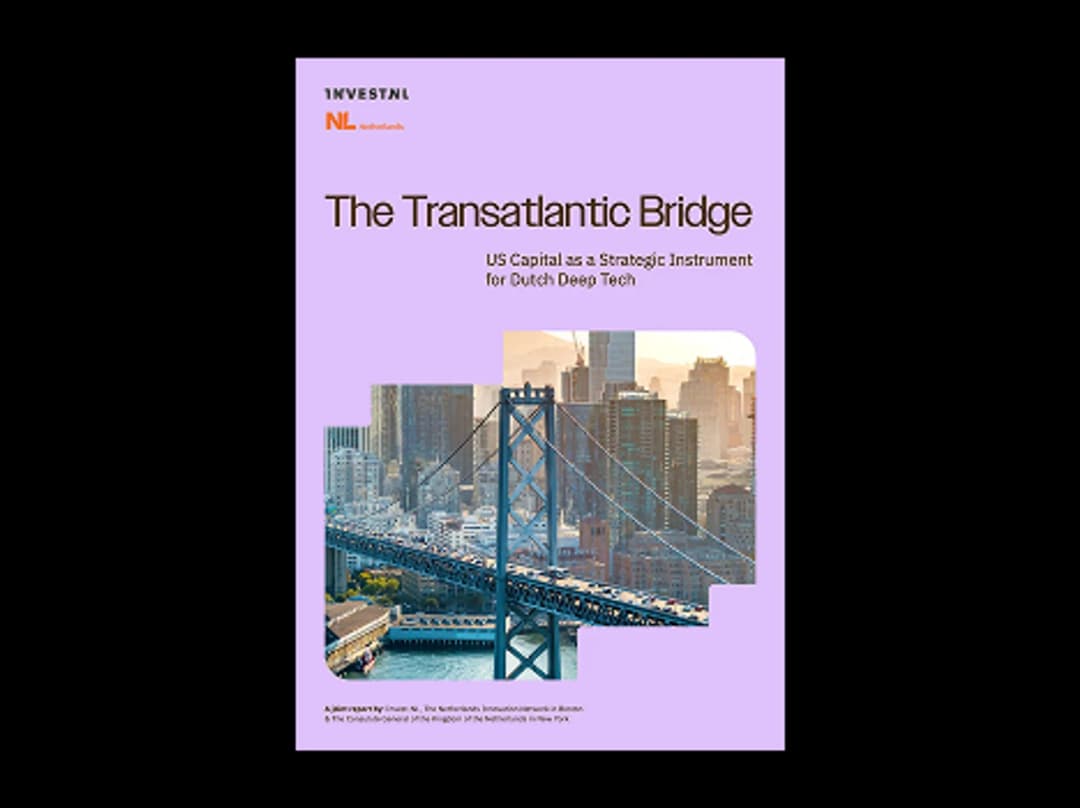
This is shown in the report The Transatlantic Bridge: US Capital as a Strategic Instrument for Dutch Deep Tech, prepared by Invest-NL, the Netherlands Innovation Network in Boston, and the Consulate-General of the Kingdom of the Netherlands in New York.
Although Dutch deep tech is technologically among the top in the world, building global technology companies also requires access to international growth capital markets, large customers, strategic partners, and exit routes. The United States is crucial for access to large clients, larger investment rounds, specialized investors, corporate partners, and exit markets. Moreover, the American market, compared to Europe, offers a more homogeneous scale market. This allows commercial validation and scaling to often happen faster, while attractive price levels can further enhance the revenue potential.
The report shows that American involvement does not automatically mean that the technological core leaves the Netherlands. Virtually all deep tech companies choose a layered expansion model: commercial presence, customers, and investors in the US, while R&D, engineering, talent, and core technology remain rooted in the Netherlands.
"The strongest deep tech companies need both Dutch roots and a global scale," says Liz Duijves, senior investment manager at Invest-NL and author of the report. "American capital can help Dutch companies grow worldwide, but we need to ensure that knowledge, talent, strategic control, and economic value remain connected to the Dutch and European ecosystem."
The report shows that American participation mainly concentrates in later stages of growth rounds, precisely when strategic choices are made regarding market access, intellectual property, governance, financing, and exit routes. Therefore, Dutch and European investors must remain sufficiently involved in the growth rounds of companies that are important for the future economy.
The report advocates for a more strategic approach to trans-Atlantic growth. Other European countries are already actively positioning their ecosystems toward American investors, strategic partners, and customers. The Netherlands should not approach American interest in deep tech reactively but actively use it to position itself as one of Europe's most relevant deep tech hubs.
Therefore, the report offers five recommendations:
"If the Netherlands wants to strengthen its technological position, we need to organise the trans-Atlantic bridge more smartly," says Liz. "This means: better preparation of companies, sharper selection of investors, clear rules regarding strategic value, and a stronger exit flywheel that ensures success flows back to the next generation of Dutch deep tech companies."
Invest-NL emphasises that American involvement is not a substitute for strengthening Dutch and European capital markets. The US can help scale promising companies faster in the short term, while the Netherlands and Europe continue to develop their own financing capacity, strategic autonomy, and industrial competitiveness. This also requires stronger Dutch co-investment capacity in growth rounds, so that Dutch public and private parties not only follow but can strategically participate when companies grow further.
The report The Transatlantic Bridge: US Capital as a Strategic Instrument for Dutch Deep Tech has been compiled by Invest-NL, the Netherlands Innovation Network in Boston, and the Consulate General of the Kingdom of the Netherlands in New York. The report is based on over 50 interviews with American investors, Dutch founders, ecosystem partners, and public stakeholders, supplemented with quantitative analysis of trans-Atlantic investment flows.
Liz Duijves
sr. investment manager