Agrifood
—30 oktober 2026
October 30, 2026
4 minutes
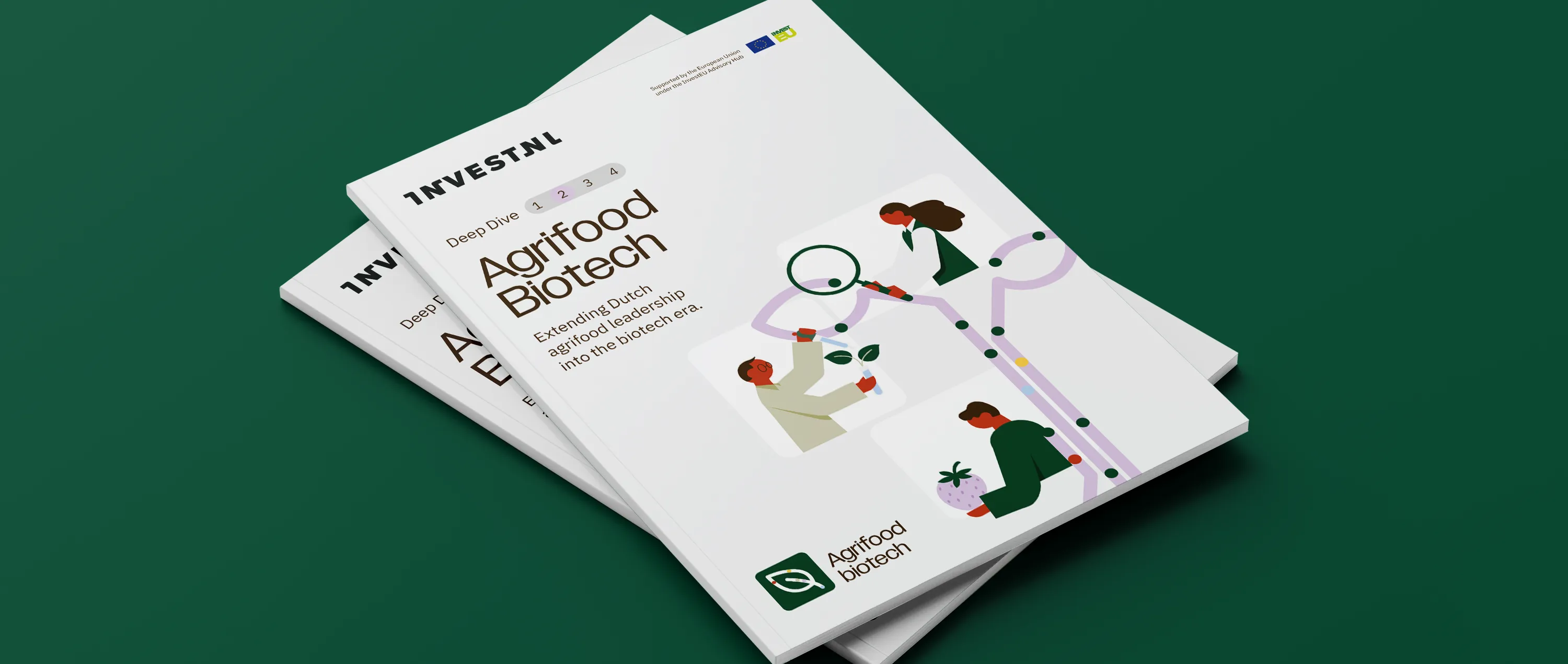
The Netherlands has everything it needs to remain at the forefront of agricultural and food innovation internationally. From crops that are better able to withstand climate change to biological crop protection and new proteins produced through fermentation: Dutch knowledge and technology offer major opportunities for economic growth and a more sustainable food system. To seize these opportunities, innovative biotech companies must be able to reach the market more quickly and scale up. This is the conclusion reached by Invest-NL in its new agrifood biotech deep-dive report.
If these companies can reach the market and scale up more quickly, Dutch agrifood biotech companies could generate around €17 billion in additional annual turnover by 2040, according to the scenario analysis. The report is based on interviews with more than 150 entrepreneurs, investors, researchers and policymakers, as well as fifteen years of investment data, and maps out the key growth opportunities and barriers.
The report illustrates why these companies struggle to grow further, including through the example of biological crop protection, in which the Netherlands is a global leader. Authorisation for a new product can take eight to ten years in Europe. The rules were largely written for chemical products and therefore do not always fit biological alternatives well. Partly as a result, companies choose to launch their products first in Brazil and the US. According to the experts, this means that the Netherlands is failing to keep pace with a market that will be seven to ten times larger by 2040.
The same challenge arises with new food ingredients, such as proteins produced through fermentation. In Europe, they wait one to three years longer for authorisation than in the US. And anyone seeking to scale up faces the cost of a first factory: quickly amounting to tens or hundreds of millions of euros. There is no financing route for this. Existing support schemes often do not fit, and sometimes even exclude these companies, precisely because they operate at a loss for years. With the right choices, Dutch companies could generate around €8 billion a year from these ingredients in 2040. With no change in policy, that figure would remain at approximately €2 billion.
“The science is improving all the time. The real challenge is financing the journey to commercial scale,” says Corjan van den Berg, co-founder of Revyve, which produces proteins from yeast. “Investors alone cannot bear this burden. Companies also need loans, guarantees and grants to make the transition to industrial production.”
Seizing these opportunities requires coordinated action. More companies need to be established, the rules and access to testing facilities need to improve, customers need to come on board earlier, and public capital can help share the risks of a first factory and thereby enable private investment. This does not mean lowering safety requirements. Rather, the rules must fit what is being assessed. Nor does the Netherlands have to produce everything itself. The aim is to ensure that knowledge, companies and strategic parts of the value chain remain in the Netherlands.
“The Netherlands is well placed to lead in agrifood biotech, but that opportunity will not wait,” says Jellie Banga, Chief Business Officer at Invest-NL. “New technology needs regulators willing to approve it, farmers willing to test it, consumers and food companies willing to buy it, and investors willing to finance it. Making this happen requires collaboration across the entire value chain.”
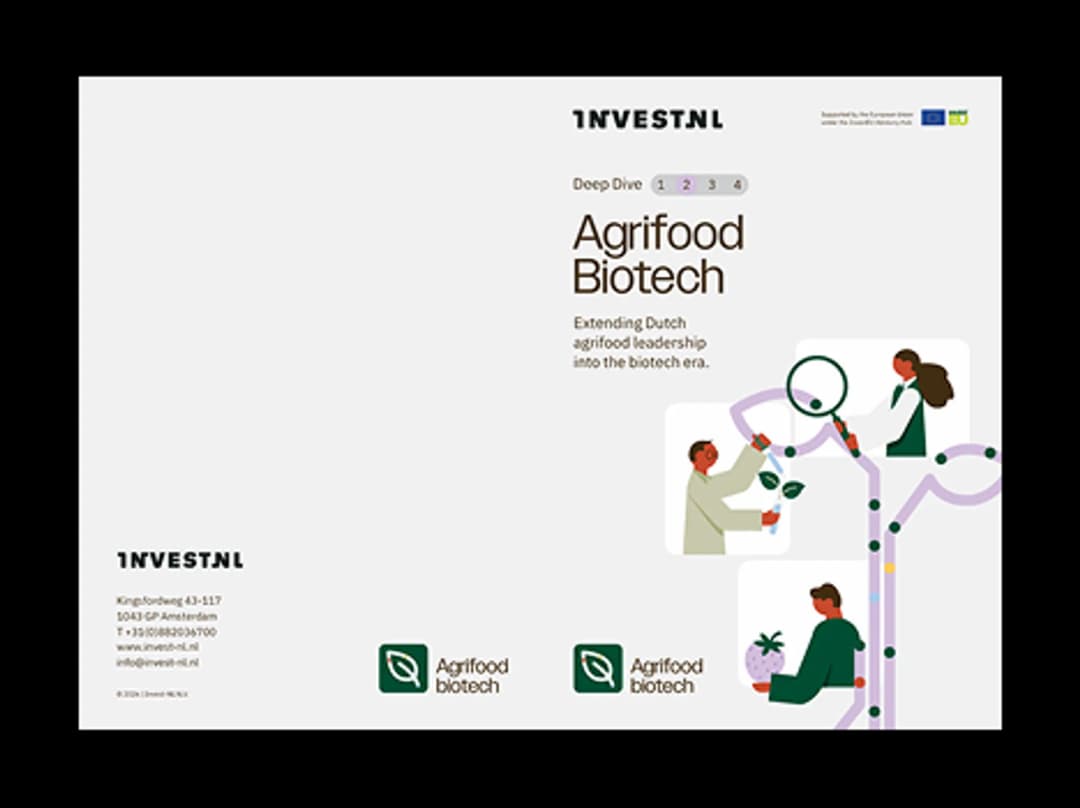
In a series of four deep dives, Invest-NL is mapping the most important biotech opportunities for the Netherlands, so that entrepreneurs, investors and governments can work from a shared understanding.
The Deep Dive Agrifood Biotech examines three value chains: seed breeding and genetics, biological agricultural inputs, and biotech ingredients and food applications. For each value chain, six factors were analysed that determine whether companies can scale up: market demand, infrastructure, talent, capital, regulation and collaboration within the ecosystem. The research is based on interviews with more than 150 entrepreneurs, investors, researchers and policymakers, as well as investment data from 2010 to April 2026. The research is supported by the European Union through the InvestEU Advisory Hub.
Michiel Strijland
sr. business development manager